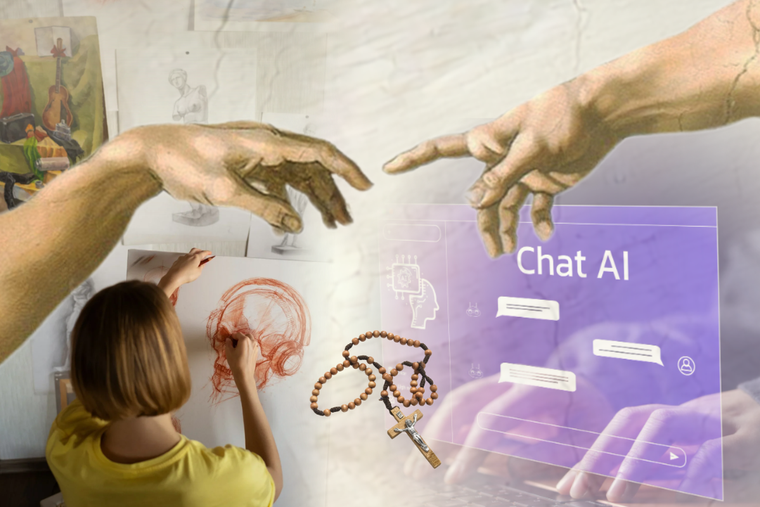
Like many other Catholics, Eliza Monts was eager to read Pope Leo’s guidance on artificial intelligence (AI) when his highly anticipated encyclical Magnifica Humanitas dropped in May.
A writer and popular social media content creator who lives in Charleston, South Carolina, Monts decided to distill the Pope’s analysis of AI into an objective list of pros and cons. “Increased speed and efficiency at performing tasks” was listed as a “pro,” for instance, while the negative effects of AI overuse on young people’s education went in the “con” ledger.
But after closely reading the Pope’s 42,000-word encyclical, the breakdown wasn’t particularly close. Monts counted just five pros — and 37 cons.
The exercise only served to strengthen the convictions Monts already held about AI.
“Being a human being matters, and is distinct, because we are made in the image and likeness of God, and a robot is not,” Monts, 27, told the Register in an interview. “I believe strongly in the movement that does not want to see the human sidelined in favor of the robot.”
The “movement” Monts speaks of is a growing number of Catholics who have decided not to use AI, specifically the “generative” variety: technology that purports