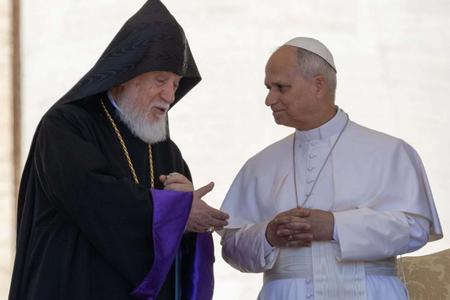
When the Catholic Church is mentioned, many think exclusively of the Latin Church, to which the vast majority of the worldʼs Catholics belong. However, the Catholic Church is actually composed of 24 “sui iuris” or autonomous Churches: the Latin Church and 23 Eastern Catholic Churches, which are heirs to the ancient Christian traditions of the Middle East, Eastern Europe, Africa and India.
These Churches have preserved their own liturgical languages, spiritualities, disciplines and forms of ecclesiastical organization. Some celebrate the liturgy in Arabic, Syriac, Geʼez, Coptic, Armenian or Church Slavonic. Others maintain traditions that date back to the early communities founded by the apostles.
All of them are in full communion with the pope, the successor of St. Peter and head of the worldwide Catholic Church.
One Church, Many Traditions
The Eastern Catholic Churches stem from five major liturgical traditions: Alexandrian, Antiochene, Armenian, Chaldean and Byzantine. Each possesses its own theological, spiritual and cultural heritage, developed over centuries within vastly different historical contexts.
Among them are well-known Churches such as the Maronite Church of Lebanon, the Ukrainian Greek Catholic Church, the Syro-Malabar Church of India, and the Coptic Catholic Church of Egypt. Many exist as minorities in countries where Islam