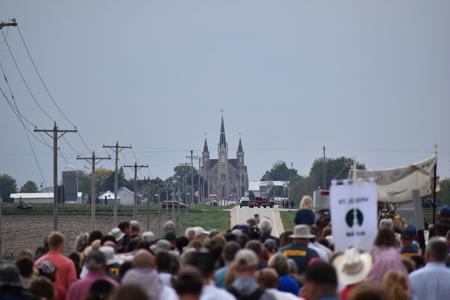
America’s apparent Catholic revival appears strongest among the college-educated but may be leaving working-class people behind.
Does this also mean that the Catholic convert numbers are the highest in major metropolitan areas where the white-collar demographic tends to congregate, while more blue-collar rural dioceses are stagnating?
The answer, paradoxically, is No.
Leading up to Easter, the Register collected data on total conversions in dioceses across the country and compared the numbers to last year. While some dioceses that include major metros made the top 10 for percentage increase in conversions — St. Petersburg (84%) and Kansas City-St. Joseph (70%) — the list is dominated by more sparsely populated rural dioceses.
None of the top three dioceses — Norwich, Connecticut (112%), Pueblo, Colorado (105%), or Rapid City, South Dakota (96%) — have a metro area with more than 300,000 people. And in total, six of the top 10 don’t include a metro area of 1 million people.
Additional data collected by Hallow was consistent with the pattern, with rural dioceses like Duluth, Minnesota (145%), Gaylord, Michigan (100%), and Altoona-Johnstown, Pennsylvania (83%), well above the national average increase of 38%, according to the prayer app company’s analysis.
Because both