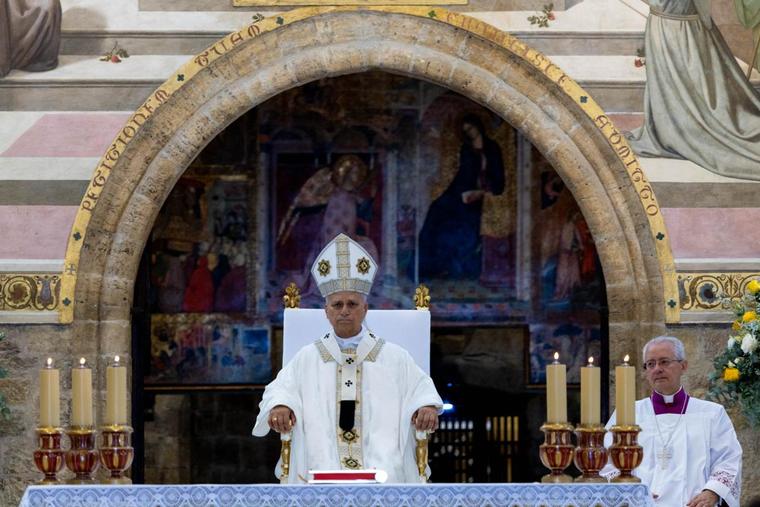
What do the Holy Father’s two roles mean in the context of his day-to-day work as the visible leader of the world’s Catholics?
Unique among world leaders, the pope serves simultaneously as the universal spiritual head of the Catholic Church and as the head of the Holy See, a distinct sovereign entity under international law that serves as the central government of the Catholic Church.
So what do these multiple roles mean in the context of a pope’s day-to-day work as the visible leader of the world’s Catholics?
Andreas Widmer, a former Pontifical Swiss Guard who served St. John Paul II and who now teaches at The Catholic University of America in Washington, D.C., told EWTN News that the papal states once formed a substantial territorial kingdom in central Italy with the pope as its temporal ruler.
Following Italian unification in the 19th century and the loss of most of those lands in 1870, the Church further developed the concept of the Holy See as an enduring international presence independent of extensive territory.
The 1929 Lateran Treaty formalized the creation of Vatican City State — a tiny sovereign territory of approximately 109 acres centered on Vatican Hill — providing