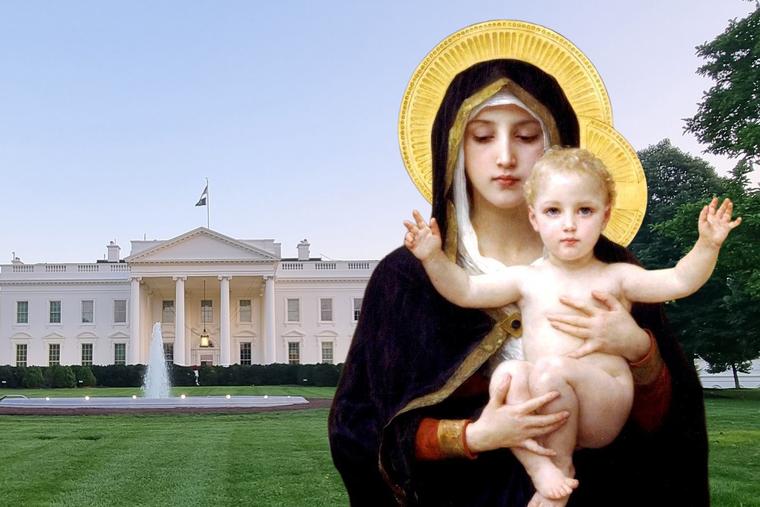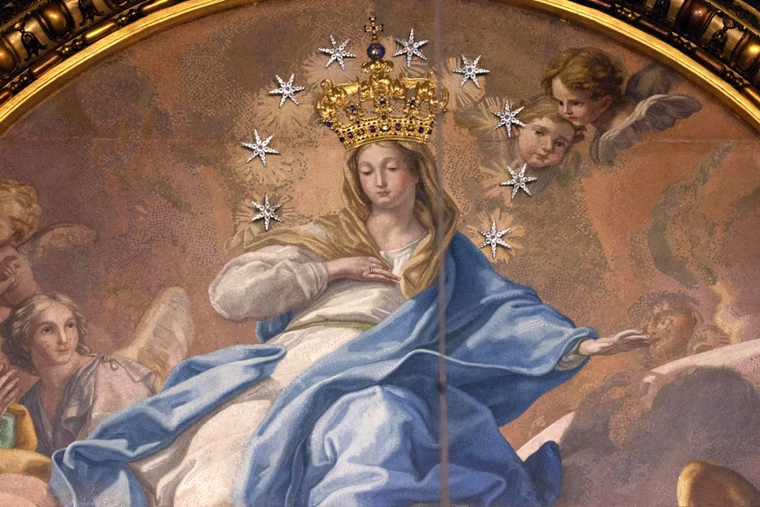
We cannot celebrate the birth of Jesus at Christmas without Mary. Nor can we observe Advent without the Blessed Mother.
“Among creatures, no one knows Christ better than Mary; no one can introduce us to a profound knowledge of his mystery better than his Mother,” wrote St. John Paul II in his apostolic letter Rosarium Virginis Mariae (The Most Holy Rosary).
During Advent, then, as we get ready to welcome Jesus at Christmas, we also must joyfully take the time to celebrate and prepare with the Blessed Virgin Mary. Her intense and joyful waiting for her Son to enter the world is a model for all who want the fullness of Christ’s presence in their lives, as reflected in a quote often attributed to St. Teresa of Calcutta, “No Mary, no Jesus.”
These Advent days are marked by Marian devotion.
The Directory of Popular Piety notes that, during Advent and Christmas, the liturgy frequently celebrates the Blessed Mother, and popular piety devotes many pious practices to her.
Consider the Solemnity of the Immaculate Conception, a holy day of obligation, on Dec. 8.
“There can be no doubt that the feast of the pure and sinless Conception of the Virgin Mary, which is a fundamental preparation for the Lord’s coming into the world, harmonizes perfectly with many of the salient themes of Advent,” it explains of Dec. 8. “This feast also makes reference to the long messianic waiting for the Savior’s birth and recalls events and prophecies from the Old Testament” being “a fundamental preparation for the Lord’s coming into the world,” as it “harmonizes perfectly with many of the salient themes of Advent.”
Two days later comes the feast of Our Lady of Loreto on Dec. 10. This Marian feast day celebrates the Holy House of Loreto (transported miraculously to Loreto, Italy, now a major shrine), where the Blessed Virgin Mary said “Yes” to God and conceived Our Lord.
Then comes the feast of Our Lady of Guadalupe on the 12th. These are just some of the Marian ways to celebrate Advent.
Marian Celebration
We should align ourselves with Mary during Advent liturgies, too. In his apostolic exhortation Marialis Cultus (For the Right Ordering and Development of Devotion to the Blessed Virgin Mary), St. Paul VI wrote, “[T]he Advent liturgy, by linking the awaiting of the Messiah and the awaiting of the glorious return of Christ with the admirable commemoration of his Mother, presents a happy balance in worship. … It also ensures that this season … should be considered as a time particularly suited to devotion to the Mother of the Lord.”
And as Pope St. John Paul II explained in 2002, “The liturgy of Advent, filled with constant allusions to the joyful expectation of the Messiah, helps us to understand the fullness of the value and meaning of the mystery of Christmas. It is not just about commemorating the historical event, which occurred some 2,000 years ago in a little village of Judea. Instead, we must understand that our whole life should be an ‘advent,’ in vigilant expectation of Christ’s final coming. To prepare our hearts to welcome the Lord who, as we say in the Creed, will come one day to judge the living and the dead, we must learn to recognize his presence in the events of daily life. Advent is then a period of intense training that directs us decisively to the One who has already come, who will come and who continuously comes.”
Mary Candle
The tradition of the “Mary candle” brings Mary into Advent in another way, as EWTN resources explain.
“The vigil of the Immaculate Conception is an opportune time to introduce the children to the practice of lighting a special Advent candle in Mary’s honor,” wrote Father Edward Sutfin in his book True Christmas Spirit. He describes the taper as a beautiful candle placed in a candleholder that is covered with a white silk cloth tied together with ribbon and then placed before an image, statue or icon of Our Lady.
“This ancient custom preaches its lesson with an eloquent simplicity which is comprehensible to little children,” Father Sutfin added.
Similarly, in Family Advent Customs, Helen McLoughlin described a tradition characterized by a rose in a vase covered with a blue lace to signify the Mystical Rose. Then, nearby, is placed a white candle with a white mantle (perhaps of satin or lace, or even crepe paper) over it. A picture of the Infant Jesus can be attached to the candle to reflect Jesus as the Light of the World.
McLoughlin explained, “‘Blessed is the fruit of thy womb’ becomes a reality to the littlest children who love to learn about the Baby in Mary’s immaculate body. Mary was God’s throne room for nine months, and her part in our redemption is very great. Only He knows how often the Holy Spirit works upon children’s souls as they peek under the mantle to see the Infant whose coming they await with great expectancy. On December 8 we recite the Magnificat and sing hymns at Mary’s altar.”
She also suggests that the candle can be placed before a picture of the Blessed Mother on the feast of her Immaculate Conception. “It serves as an eloquent reminder of Mary’s eager expectation of the ‘Light of the World’ and helps members of the family keep their own light of grace burning brightly as the best preparation for His coming.”
Walk With Mary, Bead by Bead
Advent preparations would not be complete without the Rosary, particularly the Joyful Mysteries, which reflect on events leading up to and including the Nativity (and beyond).
As Pope John Paul II explained, “The Joyful Mysteries are marked by the joy radiating from the event of the Incarnation. To meditate upon the Joyful Mysteries is to enter into the ultimate causes and the deepest meaning of Christian joy. It is to focus on the realism of the mystery of the Incarnation and on the obscure foreshadowing of the mystery of the saving Passion. Mary leads us to discover the secret of Christian joy, reminding us that Christianity is, first and foremost, evangelization, ‘good news,’ which has as its heart and its whole content the person of Jesus Christ, the Word made flesh, the one Savior of the world.”
Pope Leo reminded the faithful on the day of his election, “Our Mother Mary always wants to walk at our side, to remain close to us, to help us with her intercession and her love.”
This includes, of course, these holy days leading up to Christmas.
“Advent is a Marian season,” taught Benedict XVI. “To celebrate Advent means: to become Marian, to enter into that communion with Mary’s Yes which, ever anew, is room for God’s birth, for the ‘fullness of time.’”