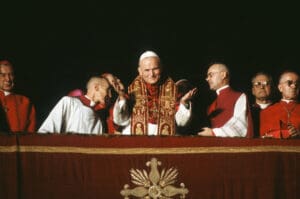
The death of Pope Paul VI on August 6, 1978 – the Feast of the Transfiguration – was not a great surprise. The pope had been in poor and declining health for some time. He had retreated to the papal summer residence at Castel Gandolfo a month before and had been bedridden for several days when he suffered a massive heart attack.
Twenty days later, the Patriarch of Venice, Cardinal Albino Luciani, was elected to succeed Pope Paul. The death of Pope John Paul I, after just 33 days in office, was a tremendous shock to a Church already reeling from some very turbulent years.
The Church, most especially in the developed world, had been tossed about in the wake of the Council. It had been more than a decade since the last papal encyclical, Pope Paul VI’s Humanae vitae. The reception (or the opposite, as the case may be) of that papal teaching was emblematic of the era. The Church seemed to be teetering between self-inflicted irrelevance through wholesale accommodation to the spirit of the age, on the one hand, and on the other, the obsolescence that comes from a stubborn refusal to have anything at all to say
Read more...