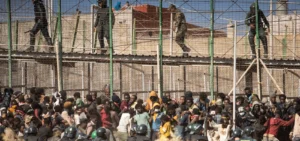
In late July, some 60,000 migrants surged into the Spanish North African enclave of Ceuta from Morocco. The migrants were mainly young males. And since 99 percent of Moroccans practice Islam, most were almost certainly Muslim. Ceuta is not a Spanish colony. It’s an “autonomous city” integral to the Spanish state, with Spanish sovereignty dating back to 1580. It’s thus a (hoped for) gateway to the European Union, and a priority target of “undocumented” immigration.
Spanish police pushed most of the migrants back across the border. They left behind – as the Wall Street Journal noted – a normally tranquil city stunned by the chaos. All of this is now old news. But what sticks in the memory is the response of the Spanish Church: an ambiguous mix of concern for the law; concern for Ceuta’s traumatized legal residents; and a vigorous worry that the incident might be used as a “political weapon” to polarize public opinion, demonize migrants, and “stoke fear.”
To the latter concern – the treatment of migrants – we’ll return in a moment. But first, some background and context.
Jacques Ellul (d. 1994) was a distinguished French philosopher and scholar of history and sociology. He was
Read more...