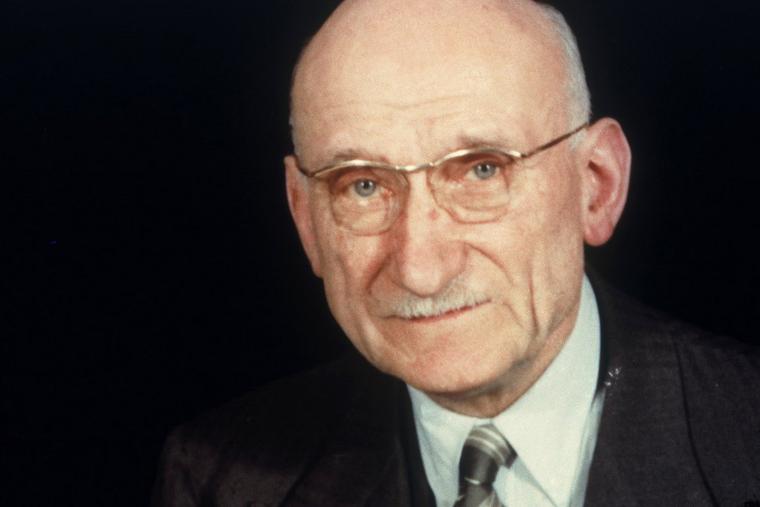
After departing Lourdes, Pope Leo XIV will spend his last day in France visiting the city of Metz, close to the borders of Germany, Belgium and Luxembourg. These World War II-era enemies achieved harmony over the last 75-plus years because the region adopted a new vision of integration advanced by Robert Schuman (1886-1963), a Catholic founding father of the European Union.
Declared “venerable” by Pope Francis in 2021, this politician’s name will ring out on Sept. 28 as papal meetings unfold at the Robert Schuman Convention Centre, then the popemobile rolls down Avenue Robert Schuman toward St. Étienne Cathedral for Mass.
Learning about Schuman and the values he pressed into service to turn Europe away from cataclysmic brutality — 30-40 million people died in the region due to wars between 1914 and 1945 — reminds us of how relevant Catholic social teaching remains today.
Fluid Borders
Schuman grew up in this region of fluid borders. Born in Luxembourg, his father was a French national whose region in the northeast, Lorraine, was annexed by Germany in 1871, automatically making him a German citizen. Schuman’s mother was a pious Luxembourger.
Schuman studied law at universities in Bonn, Munich, Berlin and Strasbourg, where